

HDx Therapy
Expanded Hemodialysis may make a world of difference for patients, clinicians and healthcare systems
One change can transform HD treatment
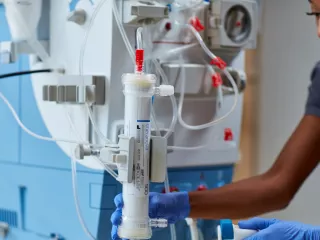
HDx therapy enabled by Theranova dialyzer* brings us one step closer to the natural kidney.1 It helps with efficient removal of large-middle molecules,2 which have been linked to inflammation, cardiovascular disease and other comorbidities in dialysis patients.3,4
HDx therapy delivers expanded hemodialysis therapy, which is a dialysis treatment that combines diffusion and convection inside a hollow fiber dialyzer equipped with MCO membrane, the medium cut-off membrane. This is possible with no special requirement of a particular hardware, preparation of replacement fluid, or additional nursing skill: HDx therapy delivery is similar to conventional hemodialysis (HD).3
- Expanded Hemodialysis enabled by the Theranova dialyzer* is a dialysis treatment in which diffusion and convection are conveniently combined along the medium cut-off membrane.
- HDx therapy is performed with no special requirement of a particular hardware, preparation of replacement fluid or additional nursing skill, compared to the necessary ones required to perform conventional hemodialysis (HD) in standard mode.3
Standardization of nomenclature
Standardization of nomenclature for the mechanisms and materials utilized for extracorporeal blood purification
Definition of extracorporeal techniques
Extracorporeal techniques in kidney failure
Classification of uremic toxins and their role in kidney failure
Advances in our understanding of uremic retention solutes, and improvements in hemodialysis membranes and other techniques designed to remove uremic retention solutes, offer opportunities to readdress the definition and classification of uremic toxins.

A randomized controlled trial of 171 prevalent HD patients showed a 45% lower all-cause hospitalization rate over 12 months with HDx therapy compared to the control high-flux HD arm.13
- Research has shown patients receiving HDx therapy may have a decreased erythropoietin resistance index (ERI). Also these patients may need a lower ESA dose over time without concomitant reduction in hemoglobin level, when compared with high-flux HD and HDF patients.12,14,15,17
- A retrospective, observational study found that, compared to HF HD, nonfatal cardiovascular events were 35% lower with HDx therapy.10
- HDx therapy may offer healthcare systems the opportunity to reduce the total cost of care, driven by potential reduction of cardiovascular events, infections, medication usage, hospitalizations, hospitalization rate and length of stay.10,11,15-17

Four principles combine in a single dialyzer device design:
- MCO membrane has increased nominal pore size that provides significantly higher permeability for large-middle molecules vs high-flux membranes used for conventional HD and HDF.1,3,19
- MCO membrane unique asymmetric 3-layer structure controls the distribution of pore sizes for a stable solutes separation profile.1
- MCO membrane’s reduced inner diameter increases the convective transport along the membrane, within the same hollow fiber dialyzer that performs diffusion.1,3,19
- Adsorptive properties of MCO membrane make it a safe and effective barrier against potential dialysis fluid contaminants despite the higher permeability.2,3,20
Going beyond urea and beta-2 microglobulin
The clinical symptoms and conditions associated with uremic toxins differ according to their molecular weight, with the large-middle molecules being linked to several clinical effects.2
Compendium of studies
Explore how the evidence on patient-reported, clinical and economic outcomes continues to grow within HDx therapy.
Brochure
Discover how HDx therapy enabled by Theranova* dialyzer may make a world of difference for patients, clinicians and healthcare systems.
Data sheet
See detailed profiles of Theranova* dialyzers
Are you interested in learning more?
Contact Vantive to learn more about HDx therapy enabled by Theranova dialyzer.
Important Safety Information
Indications for Use: THERANOVA dialyzers are indicated for treatment of chronic and acute renal failure by Hemodialysis
Caution: Do not use THERANOVA dialyzers for HDF (hemodiafiltration) or HF (hemofiltration) due to higher permeability of larger molecular weight proteins such as albumin.
For safe and proper use of the device, please refer to the Instructions for Use.
Vantive, AK 98, HDx, MCO and Theranova are trademarks of Vantive Health LLC or its affiliates.
References
-
Boschetti-de-Fierro A, Voigt M, Storr M, Krause B. MCO membranes: enhanced selectivity in high-flux class. Nature/Sci Rep. 2015; 5:18448.
-
Rosner M, Reis T, Husain-Syed F, et al. Classification of uremic toxins and their role in kidney failure. Clin J Am Soc Nephrol. 2021;16(12):1918-1928.
-
Ronco C. The rise of expanded hemodialysis. Blood Purif. 2017;44:I-VIII.
-
Hutchinson CA, Wolley M. The rationale for expanded hemodialysis therapy (HDx). Contrib Nephrol. 2017;191:142-152.
-
Meijers B, Vega A, Juillard L, et al. Extracorporeal techniques in end-stage kidney disease. Blood Purif. 2023;929–944.
-
Maduell F, Broseta JJ. Hemodiafiltration (HDF) versus expanded hemodialysis (HDx). Semin Dial. 2022;375-460.
-
Alarcon JC, Bunch A, Ardila F, et al. Impact of medium cut-off dialyzers on patient-reported outcomes: COREXH registry. Blood Purif. 2021;50(1):110-118.
-
Bolton S, Gair R, Nilsson LG, Matthews M, Stewart L, McCullagh N. Clinical assessment of dialysis recovery time and symptom burden: impact of switching hemodialysis therapy mode. Patient Relat Outcome Meas. 2021;12:315-321.
-
Molano AP, Hutchison CA, Sanchez R, et al. Medium cutoff versus high-flux hemodialysis membranes and clinical outcomes: a cohort study using inverse probability treatment weighting. Kidney Med. 2022;4(4):100431.
-
Molano-Triviño A, Sanabria M, Vesga J, Buitrago G, Sánchez R, Rivera A. Effectiveness of medium cut-off vs high flux dialyzers: a propensity score matching cohort study. Nephrol Dial Transplant. 2021;36(suppl 1):486.
-
Ariza JG, Walton SM, Suarez AM, Sanabria M, Vesga JI. An initial evaluation of expanded hemodialysis on hospitalizations, drug utilization, costs, and patient utility in Colombia. Ther Apher Dial. 2021;25(5):621-627.
-
Lim JH, Jeon Y, Yook JM, et al. Medium cut-off dialyzer improves erythropoiesis stimulating agent resistance in a hepcidin-independent manner in maintenance hemodialysis patients: results from a randomized controlled trial. Sci Rep. 2020;10(1):16062.
-
Blackowicz MJ, Falzon L, Beck W, Tran H, Weiner DE et al. Economic evaluation of expanded hemodialysis with the Theranova 400 dialyzer: A post hoc evaluation of a randomized clinical trial in the United States.Hemodial Int. 2022;26(3):449-455.
-
Lim JH, Park Y, Yook JM, et al. Randomized controlled trial of medium cut-off versus high-flux dialyzers on quality of life outcomes in maintenance hemodialysis patients. Sci Rep. 2020;10(1):1-11.
-
Sanabria RM, Hutchison CA, Vesga JI, et al. Expanded hemodialysis and its effects on hospitalizations and medication usage: a cohort study. Nephron. 2021;145(2):179-187.
-
Cozzolino M, Magagnoli L, Ciceri P, Conte F, Galassi A. Effects of a medium cut-off (THERANOVA®) dialyser on haemodialysis patients: a prospective, cross-over study. Clin. Kidney J. 2021;14(1):382-389.
-
Hadad-Arrascue F, Nilsson LG, Rivera AS, Bernardo AA, Cabezuelo Romero JB. Expanded hemodialysis as effective alternative to on-line hemodiafiltration: A randomized mid-term clinical trial. Ther Apher Dial. 2022;26(1):37-44.
-
Ronco C, Clark WR. Haemodialysis membranes. Nat Rev Nephrol. 2018;14(6):394-410.
-
Zweigart C, Boschetti-de-Fierro A, Hulko M, et al. Medium cut-off membranes – closer to the natural kidney removal function. Int J Artif Organs. 2017;40(7):328-334.
-
Boschetti-de-Fierro A, Beck W, Hildwein H, Krause B, Storr M, Zweigart C. Membrane innovation in dialysis. Contrib Nephrol. 2017;191:100-114.